

Champagne Production
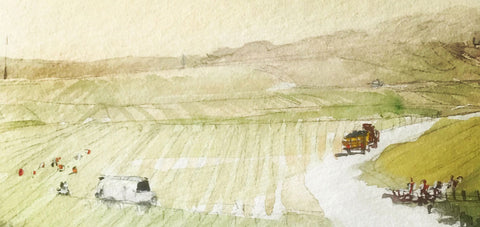

The Grape Harvest - les vendanges
The grape harvest usually takes place in late August/early September. The grapes are hand-picked and carefully transported to the press (le pressoir). From 4,000 kg of grapes, 2,550 liters of must are extracted in quick successive pressing operations. This corresponds to a yield of 102 liters from 160 kg of grapes. During pressing, there are 2 different musts. The first pressing is called "Cuvée". It is rich in acidity and will produce fresher and livelier wines with longer aging times. The 2nd and 3rd pressing, called "Taille", is used for wines with shorter aging times.
After the grapes have been pressed, the musts are clarified, an operation known as pre-clarification (le débourbage). The grape musts are cleaned of earth (dust) and pectin. Pectins are large molecules from the grape pulp that make the grape must cloudy and viscous. Since pectins and earth are heavier than the grape must, they will slowly settle at the bottom of the fermentation tank (within 12 to 24 hours). This byproduct, called lees (les bourbes), is sent to the distillery and used there.
After pre-clarification has taken place, the clear grape must must be transferred to another fermentation tank; this is called racking (le soutirage).
After racking, a little sugar is added to the grape must to improve its sugar content, as there is not enough sun in the Champagne region before the harvest. This is called chaptalization (la chaptalisation). Some winemakers decide not to chaptalize if the sugar levels are good enough or simply because they don't want to.

The First Fermentation - la fermentation
The grape must is filled into fermentation tanks (vats) or wooden barrels, which are usually made of stainless steel. The first fermentation takes place through the conversion of sugar into alcohol and is completed after 4 to 6 weeks at a controlled 18°. This alcoholic fermentation takes place by adding yeast. The yeast cells will multiply by converting the sugar into alcohol.
The wine is transferred to a new fermentation tank and cleaned of yeast.
The grape must has become wine. The winemaker can already detect the first aromas and tell whether it will be a good Champagne!

The Compilation - l’assemblage
The wines are now ready for blending after the first fermentation. The winemaker or cellar master decides which grape varieties, which vintages (called reserve wines), and which different plots, parcels or vineyards he wants to "marry" together. With these different components, he can give his Champagne its special harmony and personality. Each individual wine from the fermentation tanks is tasted and blended together in a sample rod to achieve the right composition.

The Bottling - le tirage
After blending, the wine is bottled, as legally mandated from January 1st following the harvest, but usually done in April or May for many winemakers, meaning 7 to 8 months after the harvest. Natural yeasts and a small amount of sugar are added to the wine. The bottles are then sealed with corks or capsules and are now ready for the second fermentation, which is much slower than the first.

The second fermentation - la prise de mousse or foam formation
The bottles are stored in the cellar. The second fermentation lasts at least 15 months after tirage (legally mandated). After the yeast has consumed the sugar, thereby producing alcohol and carbon dioxide, the yeast forms a deposit. During this second fermentation, the champagne gradually develops its mousse and aroma.
After 15 months of fermentation, some winemakers choose to sell the champagne (the next step is disgorgement, the removal of the yeast deposit) or they let the champagne mature further to achieve older and more flavorful aromas. For Millésime Champagnes (vintage champagnes), the fermentation period is legally set at 3 years (the next step for these champagnes is storage in the cellar).

Riddling - le remuage
After the second fermentation, the yeast deposit must be removed. For this purpose, the bottles are placed on pallets or on riddling racks (rarely) and turned every day for several weeks so that the yeast deposit slowly slides into the bottle neck towards the cork/capsule.
Riddling on a riddling rack takes approx. 1 month and on a pallet 1 week!

Storage in the cellar - le vieillissement en cave
Champagnes with a lot of "potential" (body) can be stored for 10, 15, 25 or more years! There are 2 ways to store champagne: - as a lees storage (la conservation sur lies), directly after the 2nd fermentation, without "disgorging" the champagne - the champagne is disgorged, the lost amount of deposit is refilled, and then stored. These two methods create different color and taste sensations. Longer storage also has an effect on the effervescence. Due to the loss of pressure, the bubbles become finer and the foam less. It is even almost non-existent in older champagnes.

"Disgorging" - le dégorgement
Here, the yeast sediment is to be expelled from the bottle. To do this, the bottle neck is immersed in a bath of approx. -30°C, so that the yeast sediment freezes. The bottle is uncorked and the internal pressure expels some frozen champagne with the yeast sediment.
The yeast sediment can also be removed by a rarer and very delicate process - in French it is called "dégorgement à la volée". The yeast sediment is expelled from the bottles by hand with the help of a "dégorgeuse".
Because some champagne is lost in the process, it is topped up with champagne, mixed with a small dose of cane sugar. The champagne becomes extra-brut, brut, sec or demi-sec, depending on the amount of sugar.

The Equipment
Finally, the bottle receives its final cork, which is secured with a solid wire cage. Most of the time, the bottles remain in the cellar for another 3 to 4 months after disgorging so that the added sugar mixes well with the wine. For the finishing touches, a tin foil capsule, a neck frill, and a front and back label (not always) are applied. Once equipped in this way, the champagne is ready for shipment.
